About
The ICS (Integrated Core Services) provides the core of the EPOS e-infrastructure ensuring interoperability between the data and services provided by the TCSs and the National Research Infrastructures (NRIs).
The ICS system architecture has been designed to provide the tools to facilitate the discovery of Data, Data products, Software and Services (DDSS) and the integration of these resources to fulfil users requests across the EPOS community.
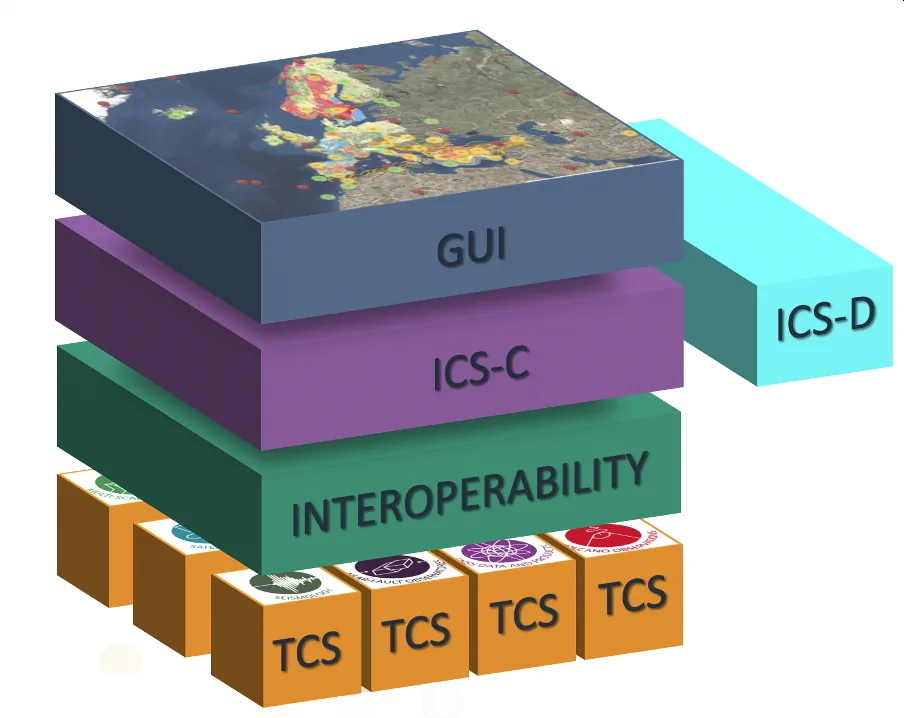
EPOS is based upon a clear architecture composed by the following layers:
EPOS Graphic User Interface
Data, data products and services integrated within EPOS system can be accessed by means of a GUI.
A web prototype is available here.
It includes search, filtering, download, pre-visualisation and a user workspace where configured datasets and services can be visualised or downloaded or pushed to ICS-D for processing or visualisation.

Central Hub system
ICS-C is the place where integration of data, data products and services occurs. It’s made up of three main modules:
- the WEB APIs, used by the EPOS Graphic User Interface to communicate with the ICS-C system;
- a Microservice-based, modular architecture that enables the system to run in a distributed environment, to adopt a software-independent approach ensuring up-to-date technological upgrades, to properly scale specific system functionalities, to enhance reliability, to isolate independent software applications running in a shared environment, e.g. by using Docker;
- a Metadata Catalogue, the key technology enabling ICS-C to manage and orchestrate all resources required to satisfy a user request.
Metadata are used for discovering data or other digital objects, contextualise them (for relevance and quality) access them, send them to a processing facility depending on the constructed workflow, and perform other tasks. The catalogue contains information about users, resources, software, and services other than data services.
Distributed
ICS-D extend the ICS-C in a virtualised way with additional computing facilities to support workflows, processing or visualization functionalities.
ICS-D pilot implementations are in progress with the aim of transferring data selected into the ICS-C GUI to distributed computing platform, where user-friendly environment like Jupyter Notebooks or home-made visualization (e.g. Enlighten Web) tools are available.
Interoperability
TCS nodes provide access to metadata through APIs with several different standard in terms of protocols, data and metadata format.
In order to homogenize and integrate such diversity, an interoperability layer was conceived, which includes:
- Description of TCS APIs in the EPOS-DCAT-AP format
- Procedure to ingest this information into the central metadata catalogue
- Converters for metadata and for data.
Full technical detail is available in the dedicated Interoperability page.
Thematic Core Services
Each community provides access to its resources through European-wide services called Thematic Core Services (TCS).
Access happens through TCS, the European-wide, community-specific services described above.
For each of them, a governance framework and a data provision platform is established, as in the case of EIDA/ORFEUS (Seismology).
TCS are characterized by enormous heterogeneity of data types and formats, ways of accessing data and metadata, scientific methods. As a consequence, a huge work for harmonizing data and metadata has been done.
TCS provide access to (meta) data and data products by means of machine-actionable and machine-readable Web Services APIs.
TCS are designed to be compliant with FAIR (Findable, Accessible, Interoperable and Reusable) principles, and the “FAIRification” process is undergoing for many of them.
Technical documents
Since EPOS Preparatory Phase, a number of reference documents has been produced.
Such Documents can help the various stakeholders to better understand the technical aspects of the EPOS ICT framework.
The most relevant technical resources are: