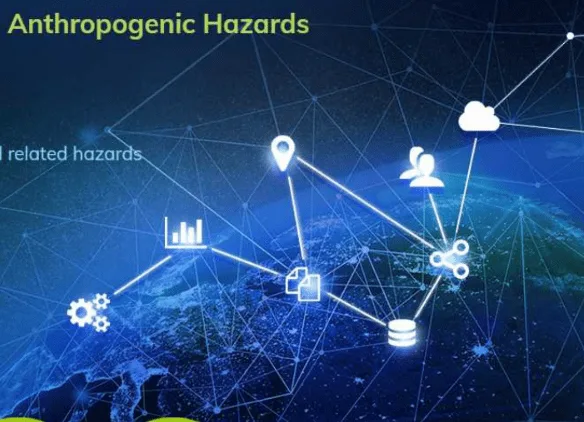
The TCS (Thematic Core Service) for Anthropogenic Hazards (TCS-AH) provides facilities, time-correlated datasets called episodes, and reference material on the EPISODES online platform to aid education and research on induced seismicity and hazards related to the exploration and exploitation of geo-resources.
About
Anthropogenic hazards arise from human activities like resource extraction, posing risks to environments and societies. Studying induced seismicity and other geohazards is critical to understanding and minimizing their impact.
Infrastructure and Collaborative Framework The TCS for Anthropogenic Hazards (TCS-AH) integrates grouped datasets termed ‘Episodes’ through the EPISODES platform. Each Episode provides time-correlated industrial data (e.g. oil/ gas production data, fluid injection rates, mine and well positions, water reservoir levels) with geophysical data (e.g. induced seismicity and ground deformation) and associated geo- and metadata. Access to facilities for data processing, analysis, visualisation and scientific products with individual or team workspace features for fostering collaboration and innovation are also provided.
Applications and Societal Impact Understanding anthropogenic hazards informs safer industrial practices and effective risk mitigation strategies. The TCS-AH supports decision-making by providing detailed analyses of human-induced seismicity and associated risks. In addition to a portfolio of applications designed for addressing anthropogenic hazards, TCS AH supports public knowledge dissemination and serves as an educational tool. It emphasizes the importance of managing and sharing datasets while respecting intellectual property rights, thereby fostering an environment conducive to research innovation.
Tools and Platforms The EPISODES platform allows users to process, visualize, and analyze data on anthropogenic hazards. Customizable tools facilitate collaborative research and tailored hazard assessments.
Future Goals and Aspirations The TCS-AH seeks to expand its dataset, enhance accessibility, and strengthen partnerships with industry and research institutions. Promoting sustainable practices and open science will advance its contributions to hazard mitigation.
The Thematic Core Service Anthropogenic Hazards provides an innovative and accessible digital environment to enable research into anthropogenic hazards related to the exploration and exploitation of geo-resources via the EPISODES Platform.
EPISODES Platform
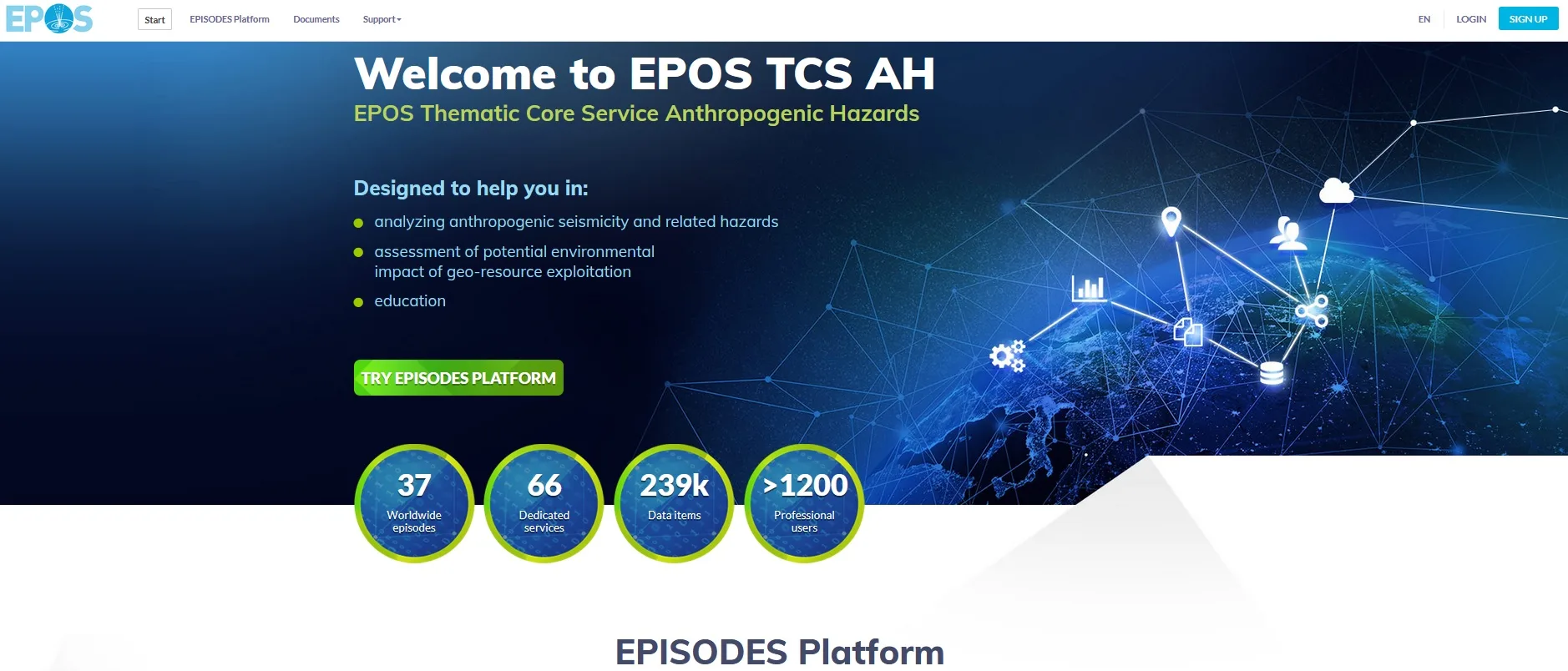
The EPISODES (European Plate Induced Seismicity Observations & Datasets within EPOS Services) Platform is a virtual laboratory that provides numerous team-working features to facilitate collaborative scientific research, make the dissemination of knowledge easier, and public participation possible through citizen science applications. It can also be used as a teaching tool on anthropogenic hazards related to the exploitation of geo-resources.
Episodes
Inside the infrastructure, data and products are grouped into “episodes.” Each episode integrates seismic and industry data, supplementing it with additionally available geo-data, such as geological, geophysical, tectonic, geomechanical, and geodetic.
Episodes aid researchers to establish correlations between induced or triggered geophysical processes and human activities for georesource exploration.
Applications
The open-access episodes are processed using the implemented software packages, or “applications”. The available problem-oriented “applications” allow researchers to investigate the links between technology, geophysical responses, and any resultant hazard.
Workspaces
Users can predefine and upload data subsets to their personal workspaces, and simulate multi-hazards incidents. In addition, the platform allows for episode-oriented research (applying various methodologies in a specific episode) or method-oriented research (performing a single methodology in several datasets).
Altogether, the TCS-AH infrastructure allows researchers to share their analysis and work with others to assess the seismic risk and other hazards of geo-resources exploitation.
Use Case Examples
Time-dependent Seismic Hazard Analysis
This application can evaluate the temporal evolution of the seismic hazard parameters to detect a causative relationship between seismic events and industrial activity. On a mining episode, it can allow the analysis of the causative relationship between seismic events and the advance of the mining front and allow hazard parameters to be estimated including the activity rate, the Gutenberg-Richter b value, the return period and the exceedance probability of a prescribed magnitude for selected seismic time windows related with the advance of the mining front.
Two options are available for creating time windows: Constant time period (duration of dataset) and constant event number (dataset size). The spatial constraints are set by defining a specified circular, rectangular or polygonal area. Four magnitude distribution estimation methods are supported. Hazard parameters are calculated and plotted for each one of the time windows for which sufficient data are available. A result of time-dependent hazard parameters in a mining environment is shown here with the episode data.
The EPISODES Platform connected to international data storage nodes integrates the research infrastructure of EPOS TCS AH. The platform contains unique datasets called "episodes", related to anthropogenic seismicity and other hazardous phenomena, comprehensively describing a geophysical process, induced or triggered by human technological activity, which poses a hazard for populations, infrastructure, and the environment.
Internal Organisation
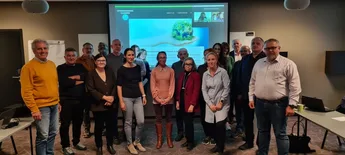
EPOS TCS AH Consortium consists of 15 European members and 1 associate member from Brazil. It gathers academic and scientific institutions, research centers, and industry and private organizations. This multidisciplinary group collaborates to provide innovative tools and datasets for education and research on induced seismicity and hazards related to geo-resource exploration and exploitation.
● 15 European members and 1 associate member from Brazil. ● A collaborative online platform, EPISODES, supporting research and teaching. ● Data grouped into EPISODES for effective correlation of seismic and human activities.
LEADERSHIP
● Chair(s): o Gilberto Saccorotti (INGV, Italy). ● Director(s): o Anna Leśnodorska (IG PAS, Poland).
CONSORTIUM COMPOSITION
● Member Organizations: o Czech Republic Institute of Geophysics, The Czech Academy of Sciences. o Finland University of Oulu. o France National Centre for Scientific Research (CNRS). Institut national de l'environnement industriel et des risques (INERIS). o Germany GFZ Helmholtz Centre for Geosciences. o Italy National Institute of Geophysics and Volcanology (INGV). o Poland Institute of Geological Sciences, Polish Academy of Science (IG PAS). Institute of Geophysics, Polish Academy of Sciences. AGH University of Krakow. Centrum Mistrzostwa Informatycznego. Drobot Popławski Przybyłowicz Liszka-Gronek (DPPL). Polish Mining Group (PMG). Wrocław University of Environmental and Life Sciences. o Sweden Luleå University of Technology. o United Kingdom Keele University. ● Associate Member(s): o Brazil Federal University of Rio Grande Do Norte.
CONTACT
● Leadership: o Gilberto Saccorotti (Chair) o Anna Leśnodorska (Director)
The TCS-AH Consortium is coordinated by IG PAS, Poland, with governance focused on fostering collaboration across its diverse members. It supports integration between academic, industrial, and scientific communities to provide tools, datasets, and platforms for assessing and mitigating anthropogenic hazards.