EPOS Architecture
National Research Infrastructures
The National Research Infrastructures (NRIs) represent the underpinning EPOS data providers that will guarantee access to quality-checked data and products. The EPOS architecture ensures that new RIs as they become operational can be integrated in future. The existing solid Earth science NRIs which support the EPOS integration plan are listed in the RIDE database. RIs contributing to EPOS will continue to be owned and managed at a national level. These have a significant economic value both in terms of construction and yearly operational costs, which are typically covered by national investments that must continue during EPOS implementation, construction and operation.
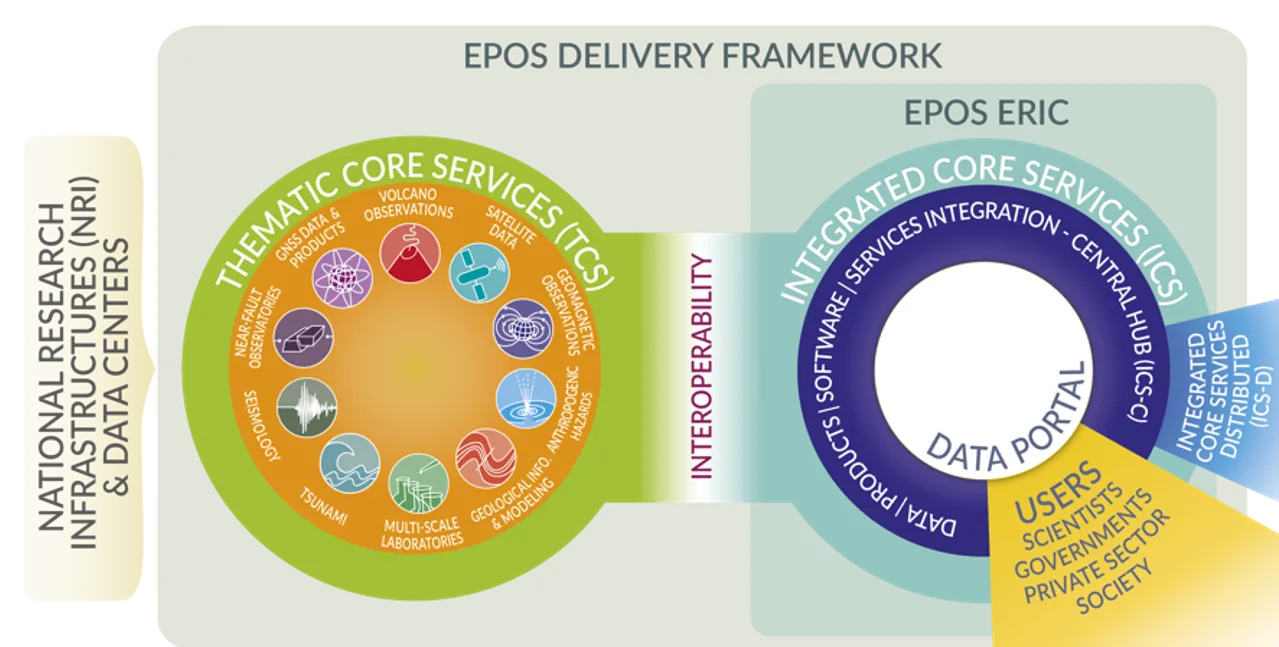
EPOS Delivery Framework
The EPOS Delivery Framework, established during the Implementation Phase (2014-2019), comprises the legal, financial and operational components that support EPOS architecture. During the current Pilot Operational Phase, the implementation of the EPOS Delivery Framework is one of the goals shared by the EPOS communities and EPOS ERIC.
The TCS-ICS federated system is the skeleton of the EPOS Delivery Framework and represents the solution for integrating distributed infrastructures via shared standards for data and metadata. This federated system will allow researchers unprecedented opportunities to use and analyze multidisciplinary solid Earth science data, detect new signals in complex datasets and lay the ground for widespread application of advanced data analysis methods in the Earth sciences.
Enabling data and service provision is essential to the construction of a long-term sustainable EPOS Delivery Framework.
Thematic Core Services
The Thematic Core Services (TCS) are the community-specific integration (e.g., seismology, volcanology, geodesy, experimental laboratories, etc). They represent transnational governance frameworks where data and services are provided to answer scientific questions and where each community discusses their specific implementation, best practices and sustainability strategies as well as legal and ethical issues. The TCS was designed taking into account the requirements of the different EPOS communities. The fact that ten TCS contributed to EPOS demonstrates the multidisciplinary breadth of the integration plan and the potential impact of the community building aspect of EPOS. TCS will be interoperable with ICS thanks to appropriate ICT solutions (the compatibility layer).