Statutes
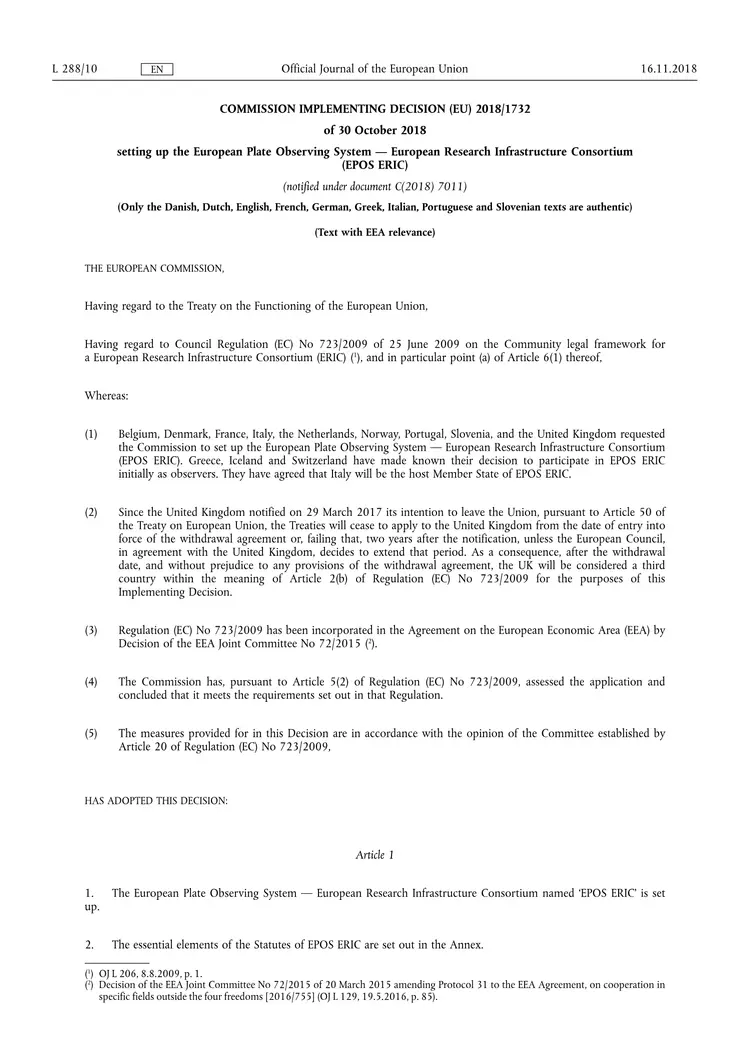
Commission Implementing Decision establishing EPOS ERIC
October 2018
Document info
Updates
Last updated: 15/09/26
Update history
- Updated 15/09/26
- Updated 14/09/26
- Updated 02/09/26
- Updated 08/06/26
- Updated 01/06/26
- Updated 21/05/26
- Created 30/04/26
Synthesis
from AIThe European Commission established EPOS ERIC on 30 October 2018 to create a distributed European Plate Observing System for geoscience research. The decision formalizes the legal framework for this European Research Infrastructure Consortium (ERIC), hosted in Italy, with 12 participating countries (including observers). EPOS ERIC’s core mission is to integrate and coordinate national geoscience data services, ensuring interoperability, open access, and global collaboration. The statutes outline governance, financial liability limits, data policies, and evaluation mechanisms, emphasizing non-economic operations while allowing limited economic activities tied to its research goals. The consortium is designed for an initial 20-year term, with provisions for winding-up and asset distribution among members.
Key points
from AI- 01
EPOS ERIC was established by the European Commission on 30 October 2018 to integrate European geoscience research infrastructure under a unified legal framework (ERIC).
- 02
The consortium is hosted in Rome, Italy, with 12 participating countries (Belgium, Denmark, France, Italy, Netherlands, Norway, Portugal, Slovenia, UK, Greece, Iceland, Switzerland) and observers from Greece, Iceland, and Switzerland.
- 03
Key tasks include coordinating national geoscience data services, ensuring open access to research data (following FAIR principles), and fostering global scientific collaboration while maintaining non-economic operations.
- 04
The statutes define governance, financial liability limits, data policies, and evaluation cycles (every 5 years) to ensure transparency and accountability.
- 05
EPOS ERIC is established for an initial 20-year period, with provisions for extension or winding-up under specific conditions.
Key words
Key prompts
Correlated documents