Communication
EPOS TCS Flyer VOLCANO 2025
March 2025
Document info
Synthesis
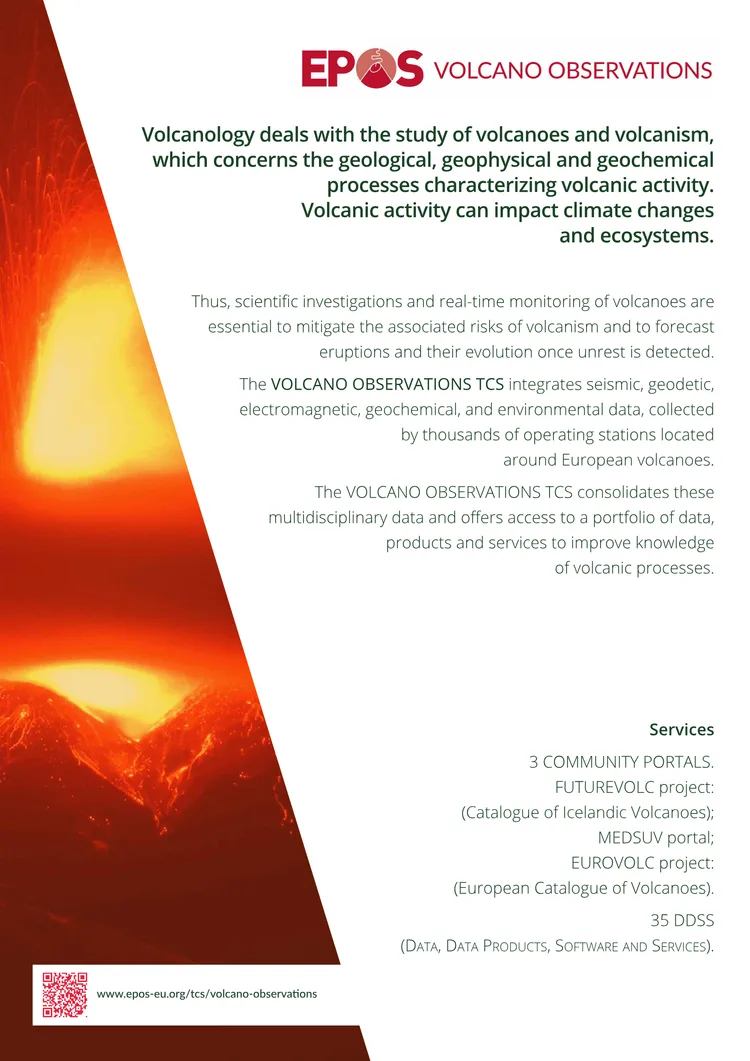
from AIVolcanology focuses on studying volcanic activity and its impacts on climate and ecosystems. The VOLCANO OBSERVATIONS TCS integrates multidisciplinary data from thousands of stations across European volcanoes to enhance risk mitigation and eruption forecasting.
This initiative consolidates seismic, geodetic, electromagnetic, geochemical, and environmental data, offering access to data, products, and services through three community portals (FUTUREVOLC, MEDSUV, EUROVOLC) and 35 DDSS (Data, Data Products, Software, and Services).
EPOS, the European Plate Observing System, serves as a distributed research infrastructure supporting long-term access to solid Earth science data, addressing societal challenges related to geo-hazards and environmental phenomena.
Key points
from AI- 01
VOLCANO OBSERVATIONS TCS integrates multidisciplinary volcanic data from thousands of European stations to improve eruption forecasting and risk assessment
- 02
Offers access to data, products, and services via three community portals (FUTUREVOLC, MEDSUV, EUROVOLC) and 35 DDSS
- 03
EPOS provides a distributed research infrastructure for long-term access to solid Earth science data
- 04
Aims to address societal challenges related to geo-hazards and environmental impacts
- 05
Collaborates with major European Volcano Observatories and Research Institutions
Key words
Key prompts
- What data sources does the VOLCANO OBSERVATIONS TCS integrate?
- Which community portals are available for accessing volcanic data?
- How many DDSS are offered by the VOLCANO OBSERVATIONS TCS?
- What is the role of EPOS in solid Earth science?
- Which institutions collaborate in the VOLCANO OBSERVATIONS community?
Related materials