Communication
EPOS TCS Flyer NFO 2025
March 2025
Document info
Synthesis
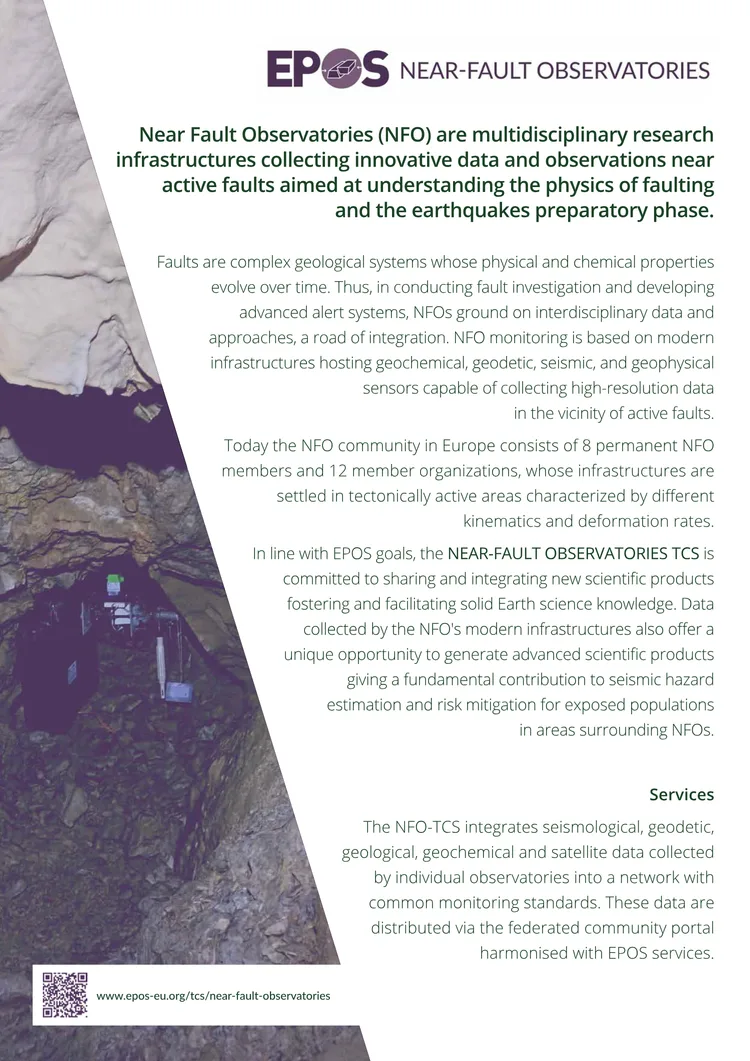
from AINear Fault Observatories (NFO) are advanced research infrastructures designed to study active faults and earthquake preparatory phases. They integrate multidisciplinary data—including geochemical, geodetic, seismic, and geophysical measurements—collected by high-resolution sensors near active faults.
The NFO community in Europe comprises 8 permanent members and 12 organizations, operating across tectonically diverse regions. Through the NFO-TCS, these observatories share standardized data via the EPOS Data Portal and FRIDGE, enabling open access to fault-zone datasets and advanced scientific products.
Key services include real-time monitoring, Early Warning System testing (CREW), and the development of ground-shaking scenarios to enhance seismic hazard assessment and risk mitigation for vulnerable populations.
Key points
from AI- 01
NFOs collect high-resolution data near active faults to study earthquake physics and preparatory phases using multidisciplinary approaches
- 02
The NFO-TCS integrates and shares data via EPOS Data Portal and FRIDGE, ensuring open access to fault-zone datasets
- 03
CREW tests Earthquake Early Warning Systems using real-time monitoring and performance evaluations
- 04
NFO data supports seismic hazard estimation and risk mitigation for exposed populations
- 05
EPOS provides a federated infrastructure for Solid Earth science data and services across Europe
Key words
Key prompts
Related materials