Communication
2025 EPOS TCS FLYER NFO 2025 ready-cut
March 2025
Document info
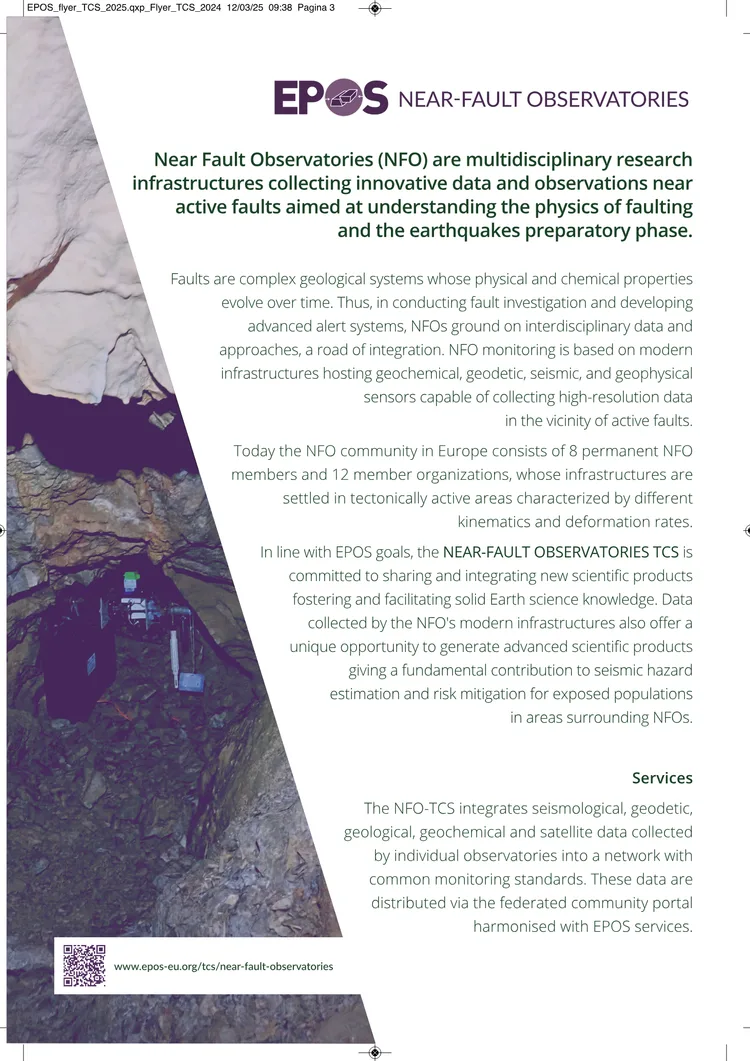
Synthesis
from AINear Fault Observatories (NFO) are advanced research infrastructures focused on collecting high-resolution data near active faults to study earthquake physics and preparatory phases.
The NFO community in Europe comprises 8 permanent members and 12 organizations, operating modern infrastructures with geochemical, geodetic, seismic, and geophysical sensors. These observatories integrate interdisciplinary data to develop advanced alert systems and improve seismic hazard estimation.
EPOS (European Plate Observing System) supports the NFO-TCS, which harmonizes and distributes data via a federated portal, offering open access to solid Earth science datasets. Services like FRIDGE and CREW enable data discovery, visualization, and performance testing of Earthquake Early Warning Systems, fostering resilience in tectonically active regions.
Key points
from AI- 01
NFOs collect high-resolution data near active faults to study earthquake physics and preparatory phases using multidisciplinary approaches
- 02
The NFO community includes 8 permanent members and 12 organizations operating modern sensor-based infrastructures across Europe
- 03
EPOS integrates and distributes NFO data via a federated portal, providing open access to solid Earth science datasets
- 04
FRIDGE offers a gateway to discover, visualize, and download NFO data and products
- 05
CREW tests Earthquake Early Warning Systems for accuracy and rapidness in fault monitoring
Key words
Key prompts
Related materials